 6 min read
 May 27, 2026
"Any sufficiently advanced technology is indistinguishable from magic."
— Arthur C. Clarke
Artificial intelligence has become one of those topics that everyone seems to be talking about. Depending on who you ask, it is either the greatest invention of our generation or the beginning of the end of humanity. I suspect the truth is much less dramatic and, at the same time, much more interesting.
I have always enjoyed understanding how things work. Whenever a new technology appears, I rarely ask whether it is good or bad. Instead, I find myself asking a different question: What is it really?
I think that question matters because names can sometimes be misleading. When we hear the words artificial intelligence, it is easy to imagine a machine that thinks the way we do. Movies have certainly encouraged that idea for decades. The reality is both simpler and, in many ways, more remarkable.
At its heart, artificial intelligence is an extraordinary pattern-recognition system.
That may not sound very exciting at first, but think about how human beings learn. A child gradually learns the difference between a dog and a cat after seeing many examples. A doctor begins recognizing patterns in symptoms. An experienced mechanic hears an engine and immediately suspects what might be wrong. A chess player starts seeing positions that once seemed completely unrelated. We spend our entire lives learning to recognize patterns.
Artificial intelligence does something surprisingly similar, although in a very different way. Instead of learning from hundreds of examples, it may analyze millions. It gradually becomes remarkably good at recognizing relationships that would take us much longer to discover ourselves.
That is why AI sometimes feels almost magical.
But recognizing patterns is not the same thing as understanding.
If I ask you why a sunset is beautiful, your answer will probably include memories, emotions, experiences, and perhaps even philosophy. Artificial intelligence can produce a beautiful answer because it has learned the patterns of how human beings write about sunsets. The result may sound thoughtful, but the process behind it is fundamentally different.
Understanding that difference completely changed the way I think about AI.
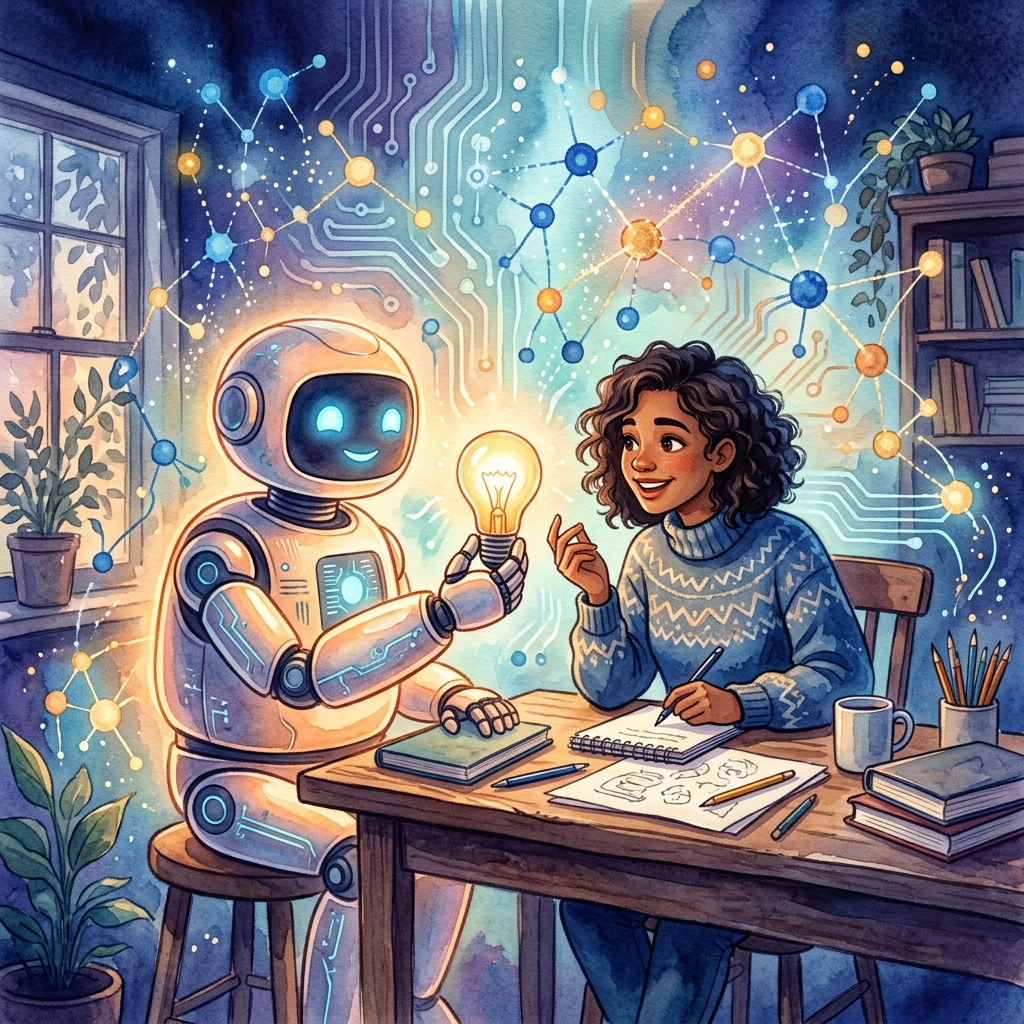
I do not see it as something that thinks for me. It helps me think better.
Many of the ideas I write about begin long before I ever ask AI anything. They usually begin with a question that refuses to leave me alone. Sometimes that question comes from a book. Sometimes from a conversation with my family. Sometimes while driving. Sometimes while taking a walk. Sometimes while trying to understand why something works the way it does.
Artificial intelligence enters much later.
It helps me organize ideas. It challenges my reasoning. Sometimes it suggests a perspective I had not considered. Other times it completely misses the point, and I reject most of what it proposes. Occasionally it points out a weakness in my argument that I had overlooked. In that sense, our interaction feels much more like a conversation than a replacement for thinking.
One analogy keeps coming back to me.
Learning to use artificial intelligence reminds me a little of learning to ride a horse.
At first it looks simple. You ask a question, receive an answer, and assume that is all there is to it. The more time you spend with it, however, the more you realize that the real challenge is learning how it responds. Every question produces a slightly different reaction. You gradually begin recognizing its strengths, its weaknesses, and the situations where you need to be especially careful. Like riding a horse, learning to use AI well is a skill that develops through practice.
The interesting part is that the learning goes both ways.
As I have learned more about artificial intelligence, I have also learned more about myself. I have become more aware of the kinds of questions I ask. I have realized that vague questions usually produce vague answers, while thoughtful questions often produce surprisingly thoughtful conversations. AI has forced me to become more precise, not because it demands perfection, but because clarity usually produces better results.
It has also taught me something else: Artificial intelligence makes mistakes.
Sometimes it misunderstands the question. Sometimes it confidently presents information that is incorrect. Sometimes it reaches conclusions that simply do not make sense. The encouraging part is that it generally does not try to hide those mistakes. If you question its reasoning or provide better information, it often acknowledges the problem and tries again.
That, I think, is an important reminder.
Artificial intelligence should not replace our judgment. It should strengthen it.
Perhaps that is one of the greatest opportunities this technology offers us. Not that it gives us answers in seconds, but that it encourages us to become better thinkers: to ask clearer questions, to verify information, to compare ideas, to recognize uncertainty, and to understand that confidence is not the same thing as correctness.
I sometimes wonder if that is where education is beginning to change. Information has become incredibly accessible. Knowing facts is still important, but perhaps understanding those facts, connecting them with other ideas, evaluating whether they are trustworthy, and using them wisely is becoming even more valuable.
Artificial intelligence can assist us in many ways:
But it cannot decide what kind of person we want to become. It cannot decide what is meaningful. It cannot decide what is worth pursuing. Those decisions still belong to us.
Perhaps that is why I find artificial intelligence so exciting. Not because I think it will replace human intelligence, but because I believe it has the potential to amplify it. Like every powerful tool humanity has ever created, its impact will depend much less on the technology itself than on the wisdom, curiosity, and judgment of the people using it.
I do not think the future belongs to those who refuse to use artificial intelligence. Neither do I think it belongs to those who blindly accept everything it says.
I think it belongs to those who learn to work alongside it, who understand its strengths, recognize its limitations, remain curious enough to keep learning, and never stop asking good questions.
Because in the end, artificial intelligence is not magic. It is simply another remarkable tool created by human curiosity.
What we build with it is still, and perhaps always will be, our responsibility.
Super Tiniux explores ideas beyond this website.
Follow us on social media for daily inspiration, discoveries, and conversations that fuel curiosity and learning.
Super Tiniux is a cozy digital space focused on curiosity, education, technology, philosophy, parenting, reading, lifelong learning, and thoughtful observations about everyday life.
© 2026 Super Tiniux. All Rights Reserved. | Developed by Oneiroi Tech